
Your Guide to Piano Makers
Learn how different brands approach craftsmanship, sound, and innovation.
Piano Making
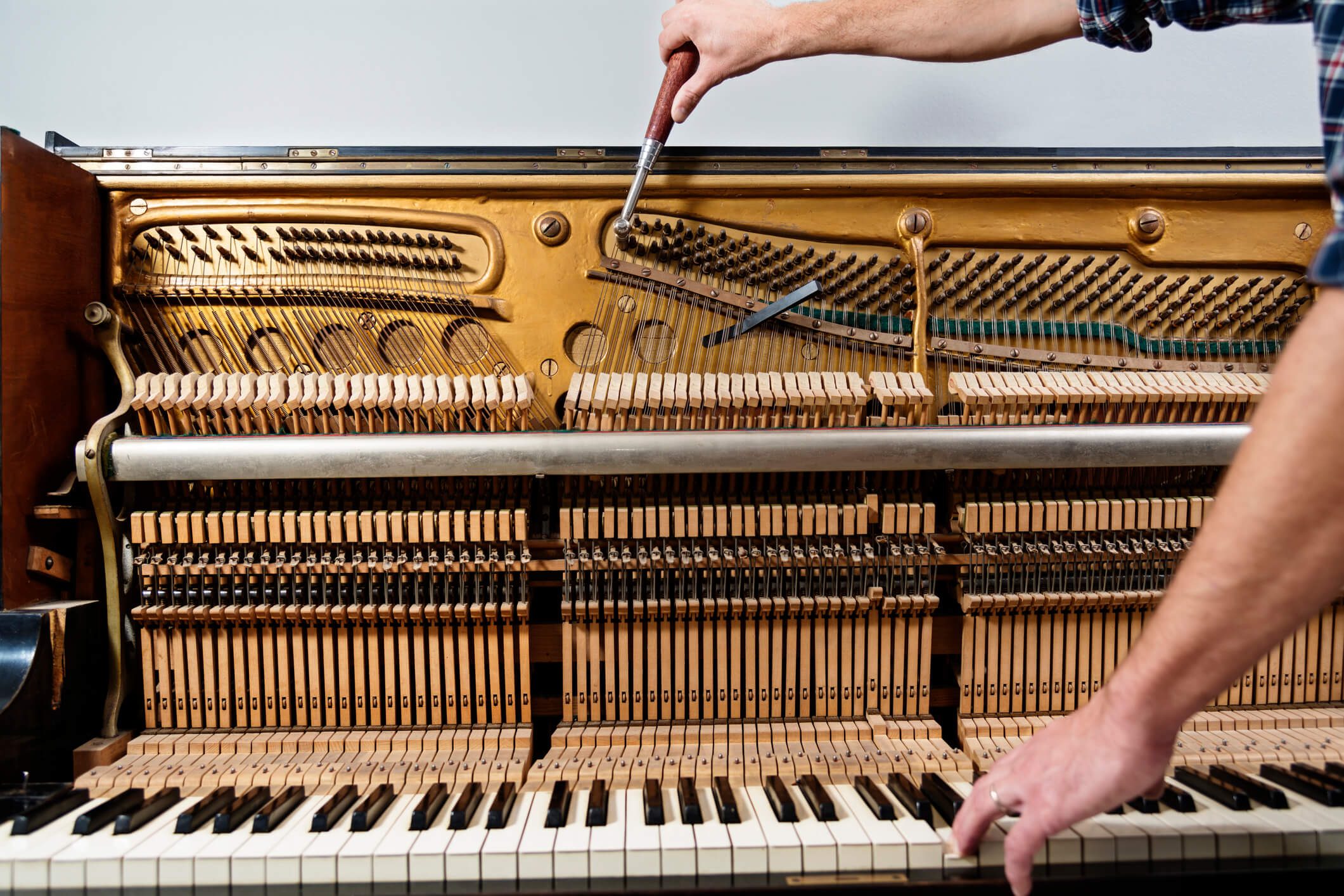
There have been many piano makers since the history of piano making began over 300 years ago in Italy, when Cristofori made the first piano. Piano making slowly developed and improved throughout the 1700s and 1800s. The process of building this instrument is very labor-intensive. Much skill and knowledge are required for makers to build a good-quality piano, although it may be almost as labor-intensive to build a low-quality instrument.
The Complexity of Piano Construction
There can be as many as 7,000 parts in a piano action, plus many more parts contained in the body or casing. The body or case is a very sturdy piece of work. It is not fragile and easily broken like TV shows or movies sometimes make it out to be. The casing is strong, thick wood tightly glued and screwed together with 4 × 4 wooden back beams for extra support, plus a heavy cast iron plate bolted and screwed to the inside of the casing. This thing is not easy to rip apart!
If someone fell inside a grand piano, even if they weighed 300 pounds, they would not tear through the casing and fall to the floor with the strings wrapped around them. The comedians you see doing this are just making fun with a prop that looks like a piano! It would take a tremendous weight and force to crash through a real grand piano. The mechanism or action inside the piano is much more delicate.

More About the Piano Industry & Its Makers
The piano was once the king of instruments, the center of entertainment, and a much-prized possession. What we call the rise and so-called fall of the piano can be traced from the mid-1800s to now (2026). We refer to its fall as “so-called” because even today many of us in America and the rest of the world still love a piano. So it’s not gone.
This fall refers to the tremendous loss of so many piano makers over the decades—not just in the United States but the entire world. Of course, China in the last 30 years has gained a lot of makers, while America has lost many. Pianos and their music still get attention, but not as much as 50 to 100 years ago.
Changes in Cultural Priorities
Nowadays, we love sports and hunting way more than a piano. No time for the arts. We’ve got to watch the game or kill a deer. Not to mention all the gadgets kids and adults have now. So in a way, maybe sports and gadgets really are killing the piano-making business.
In 1850, good pianos were luxury items that were still quite expensive—that sounds like today! Costly pianos (grands at $20,000 and up; verticals at 7 or 8 thousand and up) are the good ones. Any new grands costing $10,000 or less are the bad ones—meaning cheaply made or low quality.
Quality, Inflation, and Changing Markets
“Yes, a bad piano costs $10,000!” That’s inflation. As stuff costs more, the price of even poorly made items goes up. Of course, at some point, people stop paying good money for junk. But we still love a piano. And even an in-tune cheap piano can still sound pretty good.
By 1852, England, France, and Vienna were producing most of the approximately fifty thousand pianos being made in the world. American and German production was still small, maybe around 10,000 or less for the U.S. But that would soon change. By the late 1800s, America was producing a growing number of pianos. Total world production by 1899 was around half a million.
Affordability and Production Growth
By this time, decent pianos had become more affordable to middle-income families and musicians. This affordability lasted until about the end of the 20th century. Now it seems only the wealthy can afford a good new piano—just like in the 1800s!
Middle-income buyers may still be able to afford cheaper new pianos, but not for long. As prices rise (inflation), the average buyer will no longer be able to afford a new piano. And of course, cheap pianos will continue to be inferior and possibly become even worse.
Global Shifts in Production
Inferior pianos include some Asian pianos and other low-quality instruments. America has also produced its share of “junk.” As manufacturing costs rose, prices rose, and quality dropped—especially in middle- to low-end pianos.
One hundred fifty years ago, many workers were craftsmen. As machinery came in, it helped keep pianos affordable. But over time, old-world craftsmanship faded. Many companies lowered quality to keep prices down. After WWII, mass production increased, and workers slowly developed an “I don’t care” attitude.”
Have we grown complacent? Yes. But many of us still see the piano as “The King of Instruments.” Long live the king!
Piano Brands
Below is a partial list of piano brands and piano makers. There are hundreds. These are the more familiar names, plus some that are less familiar. Many are no longer in business. Some names have been bought by other companies. Some names that have been bought are still not back in production.
Things change. Some may be made again in the future. Very few pianos listed that are still in business resemble the original instruments. High-end pianos like Steinway do. Some high-end European ones do. Most others are made in China or elsewhere in Asia. Yamaha and Kawai, which are Japanese, range from mid-grade to high-end.
Most other Asian companies are mid-grade to low-end because of cheaper labor and materials. In the 1990s, many companies moved to China, where workers made about 50 cents an hour. Now you see why so many companies moved. Most of the time, this caused a drop in quality and changes in design.
Some American and European companies remain at home but contract with Chinese manufacturers. Others, like Kimball, changed design long before moving. Kimball stopped production in 1996.
Brand List (1–137)
Here's the list. We have indicated which ones we believe to be the best piano brands. This is based on the evaluation of current new production, along with the evaluation of the used ones that are no longer being made.
- Acrosonic: Old ones are very good.
- Aeolian
- American Piano Co.
- Apollo
- Armstrong Piano Co.
- Astin-Weight: Some say it's good and some say it's not so good. I've never seen one in my part of the country.
- Atjoli
- Atlas
- Autopiano Co.
- Bacon, Francis
- Baldwin: Old Baldwins are very good pianos. Baldwins built from roughly the late 1970's are not as good.
- Barratt & Robinson
- Baur, Julius
- Beale Piano Co.
- Bechstein, C
- Becker Bros.
- Beckwith
- Behr Bros.
- Bent, Geo. P
- Bentley
- Bogart
- Bohemia
- Borgato
- Bosendorfer: High quality and very very expensive.
- Boston Piano Co.: Good piano
- Bradbury
- Brentwood
- Broadwood & Sons
- Bush & Lane
- Bush & Gerts
- Cable
- Cable, Hobart M.
- Cable-Nelson
- Challen
- Chase, A. B.
- Chickering Bros.
- Chickering and Sons
- Clark Melville
- Conn
- Conover
- Cosmopolitan
- Currier Piano Co.
- Daewoo
- Ellington
- Emerson
- Essex
- Estey Piano Corp.
- Estonia
- Everett
- Fazioli
- Fischer
- Foster-Armstrong
- French Jesse
- Grand
- Grotrian
- Gulbransen
- Haddorff
- Hallet, Davis & Co.
- Hamilton
- Hammond
- Hardman Peck
- Harrington
- Heintzman & Co.
- Henry F Miller
- Hoffmann
- Howard
- Huntington
- Hyundai
- Ibach Sohn
- Ivers & Pond
- Janssen
- Jewett
- Kawai: Good pianos
- Kawai, Shigeru: Very expensive. Made by Kawai in Japan.
- Kemble: Good piano.
- Kimball
- Kirschner
- Knabe, Wm. & Co.: Great piano 100 years ago. It got worse over the years. Currently made in Asia.
- Knight
- Kohler & Campbell
- Krakauer
- Kranich & Bach
- Krell
- Kurtzmann
- La Petite
- Linderman
- Lester
- Lowrey
- Ludwig
- Lyon & Healy
- Marshall & Wendell
- Mason & Hamlin
- Mathushek
- McPhail
- Meister
- Metropolitan
- Monarch
- National Piano Co.
- Packard
- Pearl River
- Petrof
- Pramberger
- Samick
- Schaeffer
- Schafer & Sons
- Schaff
- Schimmel
- Schultz
- Seeburg
- Seiler, Ed
- Smith & Barnes
- Sohmer & Co: Older ones are good pianos. Not sure if it's currently made.
- Sojin
- Starr
- Starck, P A
- Steck, George
- Steinway & Sons: Very fine piano
- Sterling
- Story & Clark
- Tokai
- Tonk
- Valley Gem
- Vogel
- Vose & Sons
- Vough
- Waldorf
- Walter, Charles R.: Good piano
- Weber
- Westbrook
- Wheelock
- Whitney
- Winter & Co
- Wissner
- Wurlitzer
- Yamaha: Very good.
- Young Chang
- Zimmermann
Remember, the above list is only a partial list of piano brands and makers. It is amazing that so many piano makers have come and gone in 300+ years of piano history. We have only stopped to observe this fact in the last 5 or 10 years. We have been tuning and playing the piano for most of our lives.
Now it seems like the industry of piano making is passing away before our eyes. Of course, that’s not really true. Piano making will continue to survive, even though makers are fewer in number.